Why “Screened & Approved” Badges Fail: The Florida Homeowner’s 5-Pillar Contractor Vetting & Lien Protection Playbook
Most commercial directory badges check only a single business principal and skip active trade-license, workers' comp exemption, and subcontractor lien audits. Use this five-pillar Florida verification workflow—plus our interactive scorecard—before signing a contract or paying a deposit.

After every tropical storm, hail squall, or summer peak-season surge in Florida, residential neighborhoods fill with crisp magnetic truck decals and paid directory profiles wearing comforting "Screened & Approved" shields. Most homeowners assume those commercial badges mean a state investigator verified active trade licensing, crew workers' compensation, and clean criminal histories.
In practice, legacy pay-per-lead marketplaces routinely screen only the single person who typed in the business credit card—ignoring day-labor crews, expired corporate charters, out-of-state criminal lookback gaps, and subcontractor lien exposure. In Florida, hiring the wrong operator can leave you with an uninsurable home, personal medical liability for an injured roof worker, or a foreclosure lien on a remodel you already paid for in full.
Across Ayrianna's statewide registry of 40,013 Florida home-service businesses, core regulated trades account for 2,731 roofing firms, 2,151 HVAC contractors, 2,114 electrical contractors, and 2,003 plumbing contractors. Yet unlicensed out-of-county storm chasers routinely impersonate legitimate LLCs—making a five-minute check across three public Florida portals essential before signing any deposit check.
Why Commercial Directory "Screened" Badges Leave Florida Homeowners Exposed
Commercial directory screening badges leave Florida homeowners exposed because third-party lead aggregators typically run narrow, principal-only background checks with multi-state lookback blind spots while skipping active crew workers' compensation and municipal permit audits. A banned operator can re-enter many lead networks simply by registering a spouse's name or a fresh LLC.
Investigative reporting has repeatedly exposed the gap between consumer trust in television-advertised contractor directories and actual door-knocking reality. Even when a business principal passes a basic seven-year commercial database check, older felony convictions, out-of-state records, Alias re-registrations, and unscreened subcontractors regularly slip straight into residential living rooms.

"Experts say don't rely only on recommendations on a website—you should also check with your local building official for contractor's license and permit information, and never pay more than a third of the money up front."
— Lisa Guerrero, Inside Edition consumer investigation
In coastal Florida, the stakes extend far beyond deposit theft. Under Florida Statute Chapter 489 (§ 489.127 and § 489.128), contracting without a required state or county license becomes a third-degree felony during a declared state of emergency, and contracts entered into by unlicensed contractors are legally unenforceable. Even worse, unpermitted structural, roofing, or electrical work surfaces years later during property insurance underwriting and buyer title searches.

"What the uneducated homeowner doesn't realize is that could prohibit them from getting insurance in the future, prohibit them from selling the home when someone does a title search and finds that there's all this work that's been done, but there's no record of it—there's no permits pulled."
— Chief Eric Gandy, Clearwater Police Department joint enforcement briefing with PCSO & DBPR
During that joint undercover operation in Clearwater Beach and Madeira Beach, deputies and state investigators arrested 38 unlicensed individuals—25 of whom traveled in from outside Pinellas County—and intervened on an unpermitted $200,000 storm-restoration job where the homeowner had already handed over a $25,000 cash deposit.
The 5 Florida Verification Pillars Every Homeowner Should Audit
Vetting a Florida residential contractor requires checking five verifiable records before signing an agreement: active Sunbiz corporate standing, an exact-match DBPR or county trade license, agency-issued General Liability insurance, active Workers' Compensation coverage (checking solo-exemption abuse), and commercial auto coverage.
These exact five checks form the human audit behind Ayrianna's Gold Verified ($149/year) credential. Whether you hire through Ayrianna or vet a referral on your own kitchen laptop, run all five pillars in order:
Pillar 1: Active Sunbiz Corporate Standing (Name-Match Check)
Search the exact company name printed at the top of your written estimate on the Florida Division of Corporations (Sunbiz.org) portal. Verify that the entity status reads ACTIVE—not Inactive / Administratively Dissolved—and confirm that the Authorized Person or Registered Agent matches the business owner you are dealing with. Fly-by-night operators routinely slap "Gulf Coast Construction LLC" onto an invoice without an active corporate charter.
Pillar 2: Florida DBPR Prefix Decoder & County Licensing
Run the contractor's license number (and personal name) inside the Florida DBPR License Verification Portal (plus your local board, such as the Pinellas County Construction Licensing Board, for locally registered specialties). In Florida, state-certified prefixes (starting with C) allow statewide work, whereas state-registered licenses (starting with R) restrict work strictly to specific local jurisdictions:
| DBPR License Prefix | Legal Trade Scope in Florida | FL Directory Count | Common Red Flag to Watch |
|---|---|---|---|
| CCC (Certified Roofing) | Install, repair, waterproof & reroof shingle, metal, tile, and flat membranes statewide | 2,731 roofing firms | General handyman or pressure washer offering to "replace flashing & 40 tiles" without a CCC/CGC |
| CGC / CBC / CRC (General, Building, Residential) | Structural framing, additions, load-bearing remodels, windows/doors; CGC/CBC/CRC may subcontract or self-perform specified scopes per Ch. 489 | Statewide structural builders | Out-of-town "storm restoration consultant" renting a retired qualifier's license number ("rent-a-license") |
| CAC / CMC (Air Conditioning / Mechanical) | Central HVAC changeouts, refrigerant lines, heat pumps, ductwork & load sizing | 2,151 HVAC firms | Unpermitted weekend condenser swap that voids manufacturer 10-year parts registration |
| EC (Certified Electrical) | 200A service panels, EV chargers, boat-lift shore power, whole-home generator transfer switches | 2,114 electrical firms | Handyman swapping a recalled Zinsco or Federal Pacific panel without an EC permit inspection |
| CFC (Certified Plumbing) | Whole-home repipes, water heaters, cast-iron drain relining, backflow & sewer connections | 2,003 plumbing firms | Unpermitted water-heater or repipe work triggering immediate 4-Point insurance rejection |
Note that certain exterior maintenance trades in Florida—such as non-structural pressure washing, house cleaning, and basic lawn maintenance—do not carry a state DBPR trade license. For those trades, Pillars 1, 3, 4, and 5 separate legitimate commercial operators from uninsured cash side-hustles.
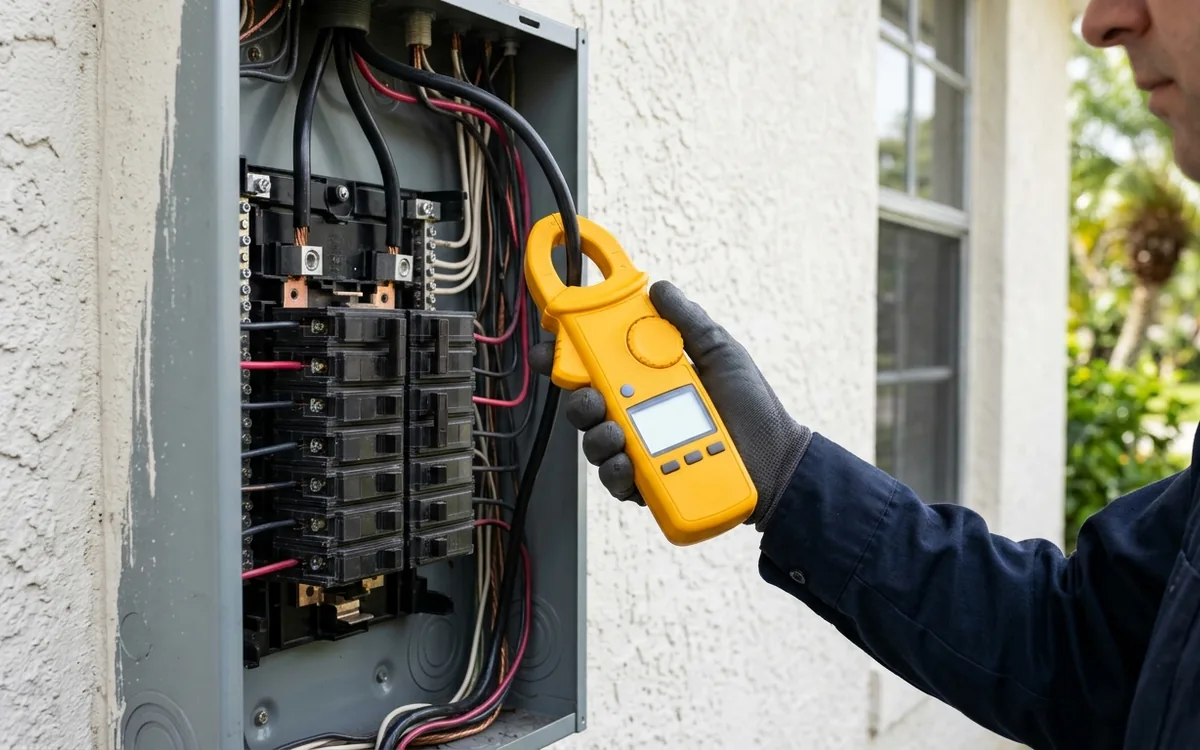
Pillar 3: Agency-Direct General Liability Certificate (COI)
Never accept a crumpled photocopy of an insurance declarations page stored inside a contractor's truck binder; scammers routinely cancel policies 48 hours after paying the first month's binder fee. Ask the contractor's insurance agent to email a current Certificate of Insurance (COI) directly from the agency domain to your inbox showing active Commercial General Liability ($300,000 to $1,000,000+ per occurrence).
Pillar 4: Florida Workers' Comp & The "Solo Exemption" Crew Trap
In Florida's construction industry, Workers' Compensation coverage is mandatory with just one employee. Many small LLC owners file a legal corporate officer exemption through the Florida Department of Financial Services Workers' Compensation Exemption database. Here is the trap: if a contractor hands you a solo corporate-officer Workers' Comp exemption, only that named officer is exempt. If five unexempted laborers climb onto your two-story tile roof the next morning and one falls, the injured worker's attorney can pursue your homeowner's liability policy.
Pillar 5: Commercial Auto & No "Owner-Builder" Permit Tricks
Heavy dump trailers, box trucks, and crane boom deliveries regularly crack decorative paver driveways and gate columns—damage excluded by personal auto policies when a vehicle is used commercially. Simultaneously, if any contractor asks you to sign an Owner-Builder Permit Affidavit at the county building department "to save time," walk away immediately: signing that form legally designates you as the general contractor, stripping you of Chapter 489 restitution protections and shifting jobsite OSHA/injury liability onto your shoulders.
Protecting Your Home Title Under Florida Statute Chapter 713 (Construction Liens)
Under Florida Statute Chapter 713, unpaid subcontractors, concrete plants, and roofing supply houses can record a Claim of Lien against your home even if you already paid your general contractor 100% in cash. Protecting your title requires tracking Notices to Owner and collecting signed Releases of Lien at every payment draw.
Homeowners across Tampa Bay, Orlando, and South Florida are stunned every year when a certified letter arrives from a shingle distributor or truss supplier demanding $9,000 for materials the homeowner already paid the primary contractor to buy. Under Florida Statute Chapter 713 Part I (Construction Lien Law), receiving a Notice to Owner (NTO) is not an accusation of wrongdoing—it is formal statutory notice that a subcontractor or materialman is preserving lien rights if your general contractor fails to pay their wholesale bill.

"The main way that contractors are protected is through the ability to record a lien—or a claim of lien—against your property... That lien becomes an encumbrance on the property just like a mortgage, and the lienor who alleges non-payment has one year to file a foreclosure suit in the public records."
— Michael S. Tobin, Esq., Florida real property attorney
To prevent double-payment liability on any project over $2,500 (or $7,500 for direct AC replacements under statutory Notice of Commencement thresholds), enforce three simple rules: cap upfront deposits at 10% to 30%, keep a folder of every NTO mailed to your home, and never release progress or final checks until the contractor hands you a signed Partial or Final Release of Lien from both their company and every NTO sender—plus a signed Contractor's Final Payment Affidavit before final closeout.
5-Pillar Florida Contractor Vetting & Lien Protection Scorecard
Check off each item you have verified for a prospective contractor before handing over a deposit check.
Hold your deposit until you verify crew Workers' Comp coverage, commercial auto, and written Chapter 713 Lien Release terms.
Skip the Guesswork: Search Pre-Audited Florida Pros
Running five separate state database checks across three bids takes roughly forty minutes—time well spent before any $10,000+ home project. When you want that legwork pre-verified by human compliance auditors, look for the Gold Verified and Verified+ shields inside Ayrianna's Pick Your Pro Directory, where every verified badge maps directly to Sunbiz, DBPR, General Liability, Workers' Comp, and Commercial Auto documentation—backed by free 14-Day Review Escrow protection.
Find a Verified Local Pro — $0 Middleman Tax
Every contractor is ranked by an unbiased True Score and vetted on real licensing and insurance — never auctioned to the highest bidder.
Are You a Local Pro? Claim Your Free Profile or Pinellas Charter Seat
Unlock uncapped direct homeowner leads for $0, free 14-Day Review Escrow protection, or lock out your trade on the 60,000-postcard EDDM Charter campaign.